
Neuroplasticity, is the ability of the brain to change throughout an individual’s life, e.g., brain activity associated with a given function can be transferred to a different area of the brain, the proportion of grey matter can change, and synapses (brain cells connections) may strengthen or weaken over time.
The story begins in the late 1970s when several groups began exploring the impact of interfering with sensory inputs on cortical map reorganization (brain centers map), They found that if the cortical map is deprived of its input, it activates at a later time in response to other input.
Their findings have been since corroborated and extended by many research groups. Merzenich’s (1984) study involved the mapping of owl monkey hands before and after amputation of the third digit. Before amputation, there were five distinct areas, one corresponding to each digit of the experimental hand. Sixty-two days following amputation of the third digit, the area in the cortical map formerly occupied by that digit had been invaded by the previously adjacent second and fourth digit zones. The areas representing digit one and five are not located directly beside the area representing digit three, so these regions remained, for the most part, unchanged following amputation (1), As you can see this study demonstrates the core concept of neuroplasticity.
Research in the latter half of the 20th century showed more interest, several conclusions were made which showed that many aspects of the brain can be altered (or are “plastic”) even through adulthood, this notion is in contrast with the previous anecdotal theories that the brain develops during a critical period in early childhood and then remains relatively unchanged (or “static”).
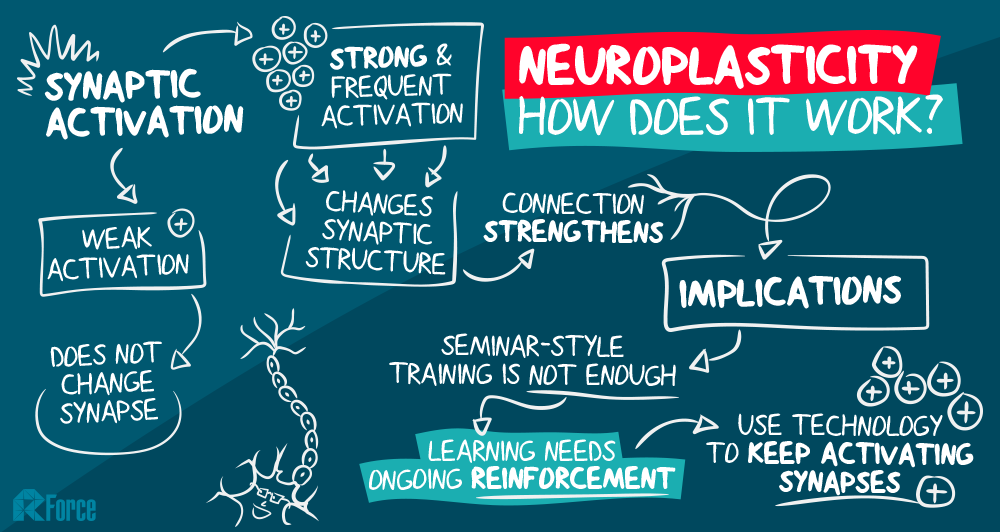
Behavior, environmental stimuli, thought, and emotions may also cause neuroplastic change through activity-dependent plasticity, which has significant implications for healthy development, learning, memory, and recovery from brain damage.
One of the fundamental principles underlying neuroplasticity is based on the idea that individual synaptic (brain cells) connections are constantly being removed or recreated, largely dependent upon the activity of the neurons (brain cells) that bear them. The activity-dependence of synaptic plasticity is often summarized by the Hebbian theory:
“neurons that fire together, wire together and neurons that fire out of sync, fail to link”
If two nearby neurons often produce an impulse in close area, their functional properties may converge. But in contrast, neurons that are not regularly activated simultaneously may be less likely to functionally converge.
A 2005 study found that the effects of neuroplasticity occur even more rapidly than previously expected. Medical students’ brains were imaged during the period of studying for their exams. In a matter of months, the students’ gray matter increased significantly in the posterior and lateral parietal cortex.(2)
Also worth mentioning that aerobic exercise promotes adult neurogenesis (new brain cell creation) by increasing the production of neurotrophic factors (compounds that promote growth or survival of neurons), such as brain-derived neurotrophic factor (BDNF), insulin-like growth factor 1 (IGF-1), and vascular endothelial growth factor (VEGF). Exercise-induced neurogenesis in the hippocampus is associated with measurable improvements in spatial memory. Consistent aerobic exercise over a period of several months induces marked clinically significant improvements in executive function and increased gray matter volume in multiple brain regions, particularly those that give rise to cognitive control.
The brain structures that show the greatest improvements in gray matter volume in response to aerobic exercise are the prefrontal cortex ( the main center of cognition and cognitive control of behaviour ) and hippocampus (the main center of emotions and memory); In addition higher physical fitness scores (measured by VO2 max) are associated with better executive function, faster processing speed, and greater volume of the hippocampus, caudate nucleus, and nucleus accumbens.
No One can reckon how the research will end or how it will shape our future, but what is clear is that the future has lots of secrets and surprises for us to discover and uncover the mystery of that black box in our heads.
References:
1-Merzenich, M.M.; Nelson, R.J.; Stryker, M.P.;Cynader, M.S.; Schoppmann, A.; Zook, J.M. (1984). “Somatosensory Cortical Map Changes Following Digit Amputation in Adult Monkeys”.Journal of Comparative Neurology.
2- [Draganski et al. “Temporal and Spatial Dynamics of Brain Structure Changes during Extensive Learning” The Journal of Neuroscience, 7 June 2006, 26(23):6314–6317]
Comments
Post a Comment